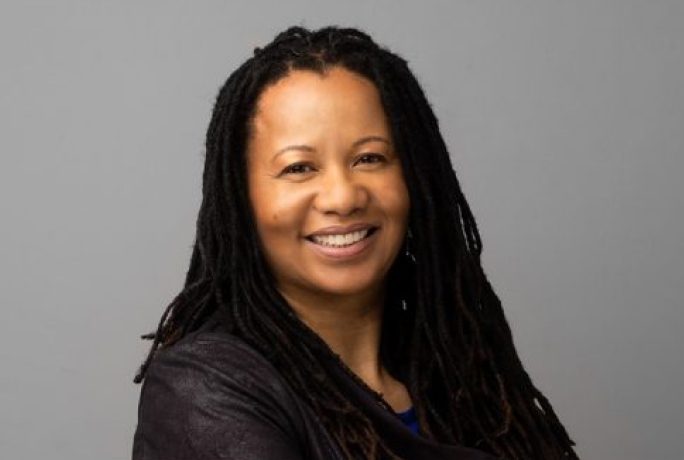
Story by Maddie Fabian
This story originally appeared on the Fine Arts Center news, UMass Amherst

Tucked in the basement of the Lederle Graduate Research Center, in the workshop of the Scientific Glassblowing Laboratory, four artists gathered during the last week of September to experiment with a practice new to most of them: glassblowing. They were on the UMass campus as part of the Fine Arts Center’s artist residency week, an initiative designed to foster creative collaboration, research, and public engagement.
Multimedia and performance artist Camille Turner, had spent thirty or so minutes fashioning a geometric sculpture out of a singular, clear, borosilicate glass rod. It was only Turner’s first go at glassblowing, but the sculpture already carried a certain weight to it, an intuitive balanced structure that felt intentional even in its experimentation.
Sally Prasch, a veteran glassblower with more than forty years of experience, took a look at the sculpture, then flipped it on its side. And with that simple act, the entire piece took on a new form, a new meaning.
“That’s exactly what it needed,” Turner said, grinning and nodding at the other artists in the room.
It was the kind of exchange, a moment when perspective quite literally shifted, that the residency week was designed to spark.
Residency program
In its fiftieth anniversary season, the Fine Arts Center is hosting four artists in residence. In addition to Turner (University Museum of Contemporary Art) and Prasch (Hampden Gallery), the group includes multidisciplinary artist and painter Angel Abreu (Augusta Savage Gallery) and playwright Michael John Garcés (performing arts).
The residency week was not only about fostering creative exchange among the artists but also about engaging with the broader university community. Over the course of the week, the artists worked closely with students, faculty, and staff, establishing relationships that will help inform their upcoming projects. These interactions are the foundation for spring exhibitions and performances that will reflect months of research and collaboration across campus.
During the academic year, these artists will translate complex social issues — including climate change, race representation in literature, Indigenous rights, and local histories of slavery — into compelling art that resonates with a wide range of audiences.
“The Fine Arts Center has a history and legacy of bringing working artists to campus to enrich the academic life of the community,” Kristina Durocher, director of visual arts, said at a public talk. “This week, the artists have been working with students, with faculty, and getting familiar with their surrounding community, as well as the many resources that the university has to offer.”
A week of exchange
Throughout the week, the artists immersed themselves in conversations with local artists, creators, and scholars, attended a reception, and joined MFA studio arts students for lunch and discussion. They toured the University Museum of Contemporary Art with student educators and visited local archives to kickstart their respective research endeavors. By the end of the week, they had begun to shape the direction for their spring projects.
At a public presentation, the artists shared their work and answered questions from students, artists, and the community. The conversation ranged from the artists’ past works and creative processes to their thoughts on pedagogy, collaboration, and the literary influences that inform their practices.
Camille Turner
University Museum of Contemporary Art

Camille Turner spent the week getting situated with her new cohort at the research institute Slavery North, where she will be based throughout the semester. She met with faculty, students, and museum curators and staff to begin early exhibition planning for spring 2026, when her work will be featured.
“What I do is called research creation,” Turner said. “It is a research-based practice, and the work comes out as artworks.”
While her research at UMass is just beginning, Turner’s practice — grounded in Afrofuturism, a movement that blends science fiction, fantasy, and Black history and culture — will continue to interrogate overlooked histories of transatlantic slavery in the U.S. and Newfoundland, as well as local histories.
“We’re living within the legacy of this history,” Turner said. “It continues to today. Every Halloween, you’ll see people dressed up in blackface. This didn’t come out of nowhere — it’s part of the legacy.
“I continue to collect and create this archive,” she added. “At this point, there are hundreds of pieces in the archive, and I’m going to be looking in the archives here [at UMass] and building it out to include this area as well.”
Angel Abreu
Augusta Savage Gallery

Angel Abreu, whose work blends painting, literature, and education, spent time in the W.E.B. Du Bois Library, researching digital archives and deepening connections to a line of inquiry that has long shaped his practice — and that shaped his work featured in the University Museum of Contemporary Arts’ landmark 2014 exhibition, Du Bois in Our Time.
His research will deepen the context of his upcoming exhibition, Crossing Narratives, which will center around the 2024 novel James by Percival Everett. The novel reimagines Mark Twain’s Adventures of Huckleberry Finn, placing the story of the formerly enslaved Jim at the forefront.
Abreu’s residency also includes a public workshop during which Abreu will collaborate with participants to create new work for the show.
“We’re gonna have some fun. We might cry, too,” Abreu said at the public talk.
“Teaching is an important part of my practice,” he said. “It’s been wonderful to engage with such thoughtful students. I came away from this week feeling invigorated and inspired.”
Sally Prasch
Hampden Gallery

Sally Prasch’s week was focused on the medium she knows well, glass. In addition to leading a glassblowing workshop, she laid out plans for her upcoming exhibition, Fragile Connections, at Hampden Gallery, in which she will address the urgency of the climate crisis.
“I come from a scientific glassblowing background,” Prasch said at the public talk. “There are people all over the world that are making scientific apparatus to help researchers. … Just think how often you use glass in your world today. It’s just about everywhere, and it’s because scientific glassblowers are there doing the work.”
Prasch met with multiple UMass partners to begin shaping her project, including staff at the Science and Engineering Library to discuss seeds and library integration; Durfee Conservatory staff to select plant species and coordinate installation planning for a teaser exhibition; and faculty at Institute for Applied Life Sciences to explore the use of scientific imagery, such as NMR scans, in her exhibition.
She was also introduced to the Five College Collections database and the University Museum of Contemporary Art’s permanent collection. And she is collaborating with a student to work with Environmental Studies faculty to bring classes to view and engage with her spring exhibition.
Michael John Garcés
Performing arts

Director Michael John Garcés, continuing a residency initiated with collaborator and theater artist Larissa FastHorse last year, is working in collaboration with the Center for Braiding Indigenous Knowledges and Science, local Native communities, and UMass theater students to develop a new performance piece rooted in documentary theater.
During the residency week, Garcés met with students in UMass professor Priscilla Page’s theater class as part of an ongoing effort to make the work collaborative, place-specific, and participatory.”
“The students are doing dramaturgical work for the project to create a piece exploring visions of the past, future, and present through contemporary Indigeneity in town,” Garcés said.
“We do that through engagement with the community and talking to people,” he said. “We’ll talk to a lot of local folks here in the next several months.”
Looking forward
Over the coming months, artists will continue their research and campus engagement through student workshops, class visits, book clubs, and ongoing meetings with faculty and research departments.
Public events include:
- Camille Turner, Slavery North fellow, Special Lectures: Identity Politics in Contemporary Art: October 28
- Workshop with Angel Abreu: February 7
- Glassblowing workshops with Sally Prasch: February 4, March 4, April 1
Stay tuned for announcements about upcoming events and spring exhibitions.